The Talking Borehole: Offline Local Voices Protecting Shared Water Sources in Bukere, Kyaka II Refugee Settlement
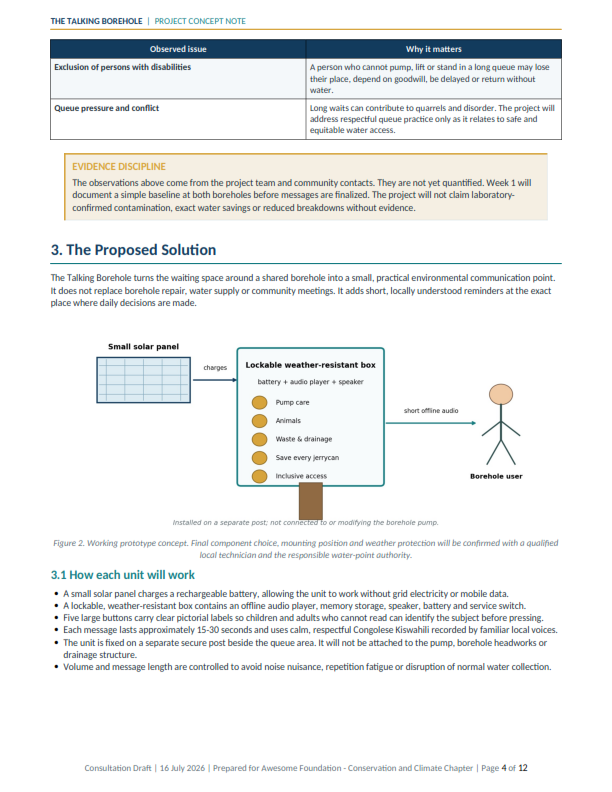
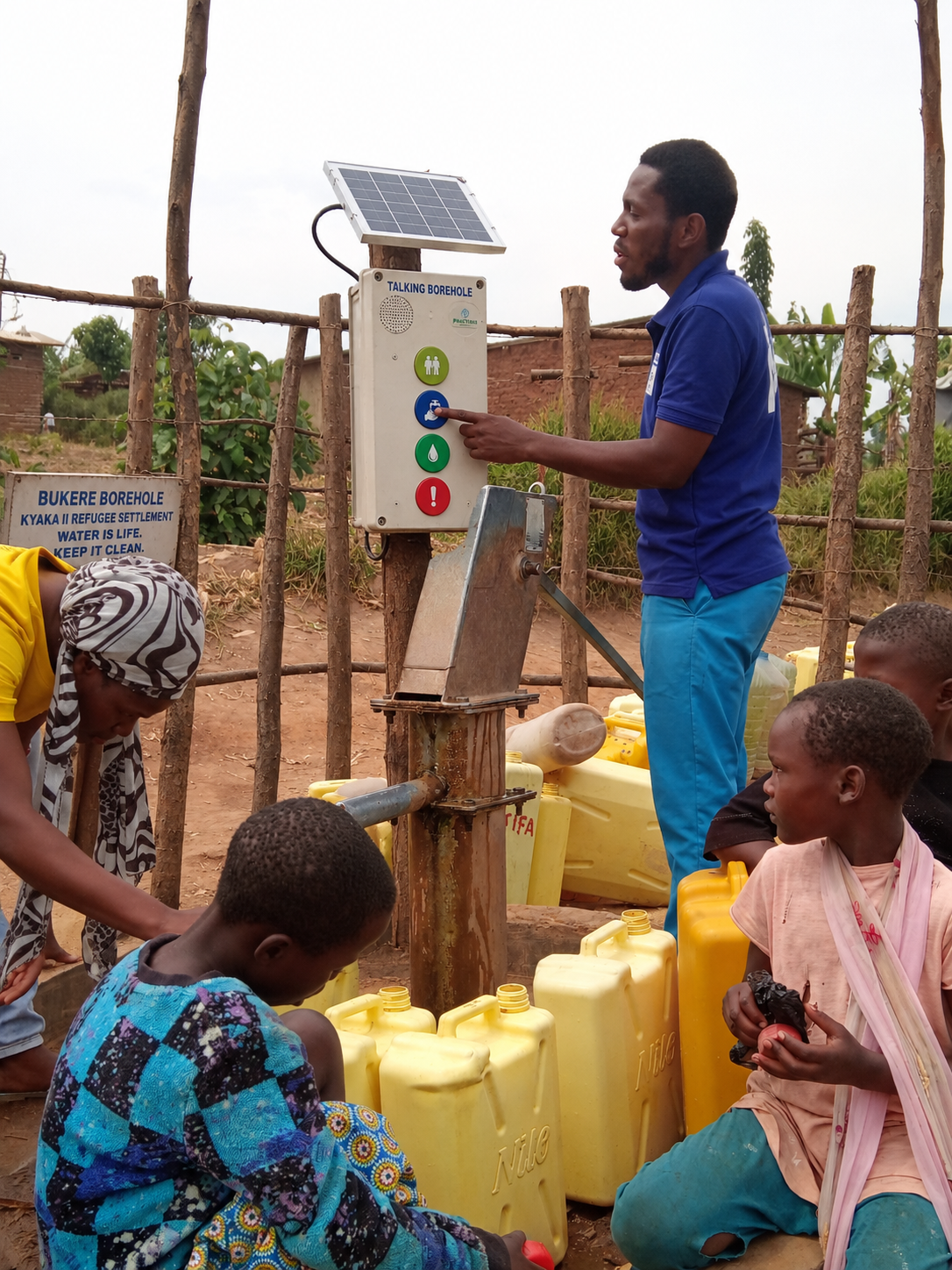
The Talking Borehole is a planned six-week pilot that will place one solar-powered, offline audio unit beside each of the shared boreholes in Bukere A and Bukere B. Large picture buttons will play short Congolese Kiswahili messages on pump care, livestock control, cleanliness, drainage, responsible use of collected water and inclusive access for persons with disabilities.
The challenge
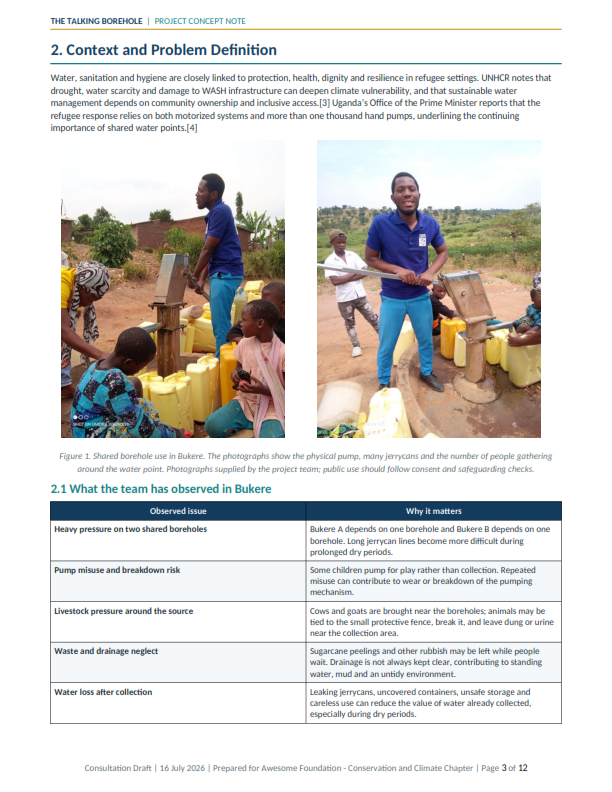
Bukere A depends heavily on one shared borehole, while Bukere B depends on another. During prolonged dry periods, long jerrycan queues increase pressure on the boreholes and the people using them. Children sometimes pump for play, which may contribute to damage of the pumping mechanism. Cows and goats may be tied to the small local fences, breaking the protection and leaving dung or urine near the water point. Sugarcane peelings and other rubbish are sometimes left behind, while drainage channels are not always kept clear. Water may also be lost after collection through leaking jerrycans, uncovered containers and careless household use. Persons with disabilities face an additional barrier because some cannot operate the pump, carry containers or remain in a crowded queue without assistance. They may be delayed, lose their place or return home without water.
Project goal
To protect the two shared boreholes in Bukere, reduce avoidable water loss and promote cleaner, safer and more inclusive water-use practices through locally voiced environmental communication delivered directly at the point of collection.
Objectives
- Install one solar-powered, offline Talking Borehole unit beside the Bukere A borehole and one beside the Bukere B borehole.
- Co-design and record short Congolese Kiswahili messages with local borehole users.
- Promote proper pump use, livestock control, cleanliness and protection of drainage channels.
- Encourage careful storage and responsible use of collected water during prolonged dry periods.
- Promote respectful queue practices and practical assistance for persons with disabilities.
- Document how users understand and respond to the messages during the pilot period.
Main activities
- Confirm the two borehole sites and secure the required community and settlement approvals.
- Conduct simple baseline observations at Bukere A and Bukere B.
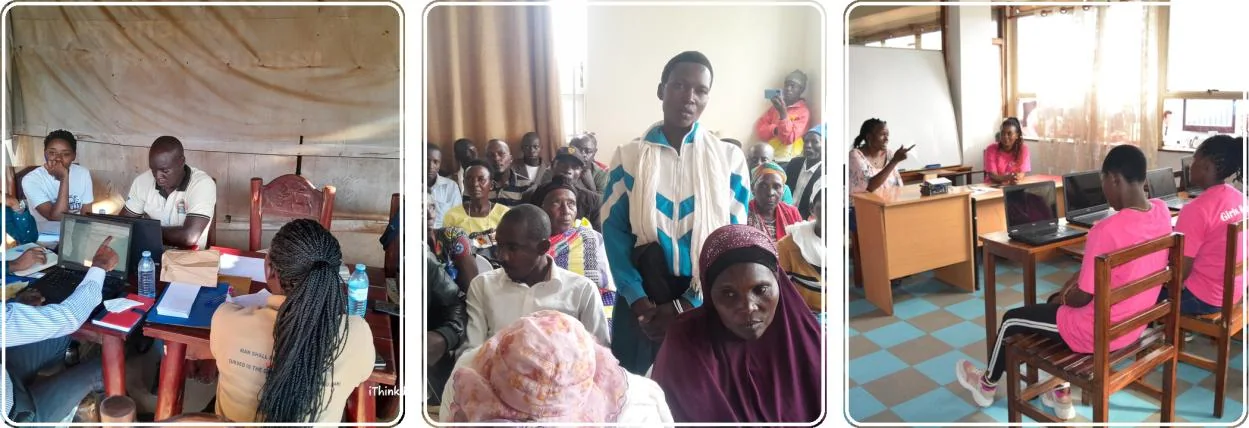
- Consult borehole users, including women, children, youth and persons with disabilities.
- Develop and test short messages in Congolese Kiswahili.
- Prepare pictorial buttons covering pump care, livestock, waste and drainage, water-saving and inclusive access.
- Fabricate two solar-powered, weather-resistant audio units.
- Install each unit on a separate secure post beside the borehole without modifying the pump.
- Demonstrate the units to community members.
- Observe use, collect feedback and improve unclear messages.
- Prepare a short learning and maintenance report.
Implementation approach
The project will use a community-led, point-of-use communication approach. Messages will be developed with local users rather than imported from outside the settlement. Each message will be short, pictorial, respectful and understandable to people who may not read written notices. The units will operate without internet, mobile data or grid electricity. They will be installed on separate posts and will not be attached to the borehole pump, pump head, drainage structure or existing water infrastructure. Technical design, mounting and weatherproofing will be confirmed by a qualified local technician.
Verified progress and results
- Project concept and technical narrative prepared.
- Two proposed borehole sites identified in Bukere A and Bukere B.
- Refugee youth co-lead identified.
- Community recommenders identified.
- Application submitted to the Awesome Foundation Conservation and Climate Chapter.
- No implementation outputs or community-level results have yet been achieved.
Partners and roles
- Richardson Kyeyune: Applicant and Project Lead; responsible for overall design, coordination, documentation, audio production, accountability and donor communication.
- Gilbert Manembo: Refugee Youth Co-Lead; responsible for community mobilisation, Congolese Kiswahili message development, local testing and communication with borehole users.
- Cairo Youth Empowerment Initiative: Proposed technical, safeguarding, documentation and learning support. CYEI was not the named applicant to the donor.
- Mr. Ndizeeyi Karani: Community recommender and proposed local adviser for Bukere A, subject to his consent and confirmation.
- Mr. Cesar Alinoti: RWC II Chairperson for Bukere Zone; proposed community-coordination and endorsement role, subject to formal consent.
- Office of the Prime Minister/Settlement Commandant and relevant settlement authorities: Required approval, coordination and oversight before installation.
- Local electronics technician: To be identified for technical design, fabrication, installation, testing and maintenance guidance.
Challenges
- Funding has not yet been secured.
- Formal site and settlement approvals are still required.
- Technical fabrication and weatherproofing must be locally tested.
- Units will need protection from rain, dust, theft and accidental damage.
- Messages must remain clear across different ages and literacy levels.
- Community queue practices and livestock movement require local agreement rather than outside enforcement.
- Public use of identifiable photographs requires consent and safeguarding review.
Lessons learned
- Early project design has shown that environmental messages must be delivered in the language people use every day and at the exact place where decisions are being made. The concept must combine pump protection, water conservation, disability inclusion and respectful community behaviour rather than treating them as unrelated issues. Technical equipment should support the borehole without being attached to or interfering with the pump.
Sustainability approach
The units will use small solar panels and rechargeable batteries, avoiding recurring electricity and mobile-data costs. Audio files can be updated through replaceable memory storage without replacing the full unit. Local users and an agreed community focal person will be shown how to operate, clean, inspect and report faults affecting each unit. The pilot will document component specifications, message scripts, installation lessons and maintenance needs so that the model can be improved or reproduced at other shared water points. Sustainability will depend on community ownership, affordable replacement parts, clear local responsibility and coordination with settlement leadership.
Participation, learning and community engagement.